Mozart Requiem Sheet Music — Soloists, Choir & Orchestra, KV 626
The complete performance edition of Mozart’s Requiem in D minor — full score, choral score and all eighteen individual parts for soloists, SATB choir and orchestra in one PDF. Edited by Paul Lorenz.
Regular price €119.00
Now
€89.90
Instant PDF download
See the score & buy
Edition facts
Requiem in D minor, KV 626 by Wolfgang Amadeus Mozart, arranged by Paul Lorenz for SATB choir and orchestra with soprano, alto, tenor and bass soloists: full score (152 pages) and separate parts (410 pages), delivered as a PDF (A4) for instant download, €89.90.
- Instrumentation
- Basset horn (2), Bassoon (2) · Trumpet (2), Trombone (3) · Timpani · Violin I, Violin II, Viola, Cello
- Choir
- SATB
- Soloists
- Soprano, alto, tenor, bass soloists
- Pages
- 562 pages — full score (152) + separate parts (410)
- Key
- D minor
- Duration
- approx. 52 min
- Difficulty
- Advanced (4/5)
- Tempo
- Adagio – Allegro
- Edition
- 2026
- Format
- PDF, A4, instant download
Read from the PDF you download.
Wolfgang Amadeus Mozart left his Requiem in D minor, KV 626 unfinished when he died in December 1791. This edition presents it in the completion by his pupil Franz Xaver Süßmayr — the version sung in most concerts and heard on most recordings. It is the complete performance edition by Paul Lorenz — conductor’s score, choral score and every individual part, delivered as one instant PDF download you own outright. Launch price €89.90 (regular price €119.00).
The edition is laid out for rehearsal and concert. Every singer gets an individual part as well as the choral score, and the solo passages stand on the choir staves, marked “Solo” and “Tutti”. Two basset horns in F, two bassoons, two trumpets in D, three trombones, timpani, the strings and the bass line for violoncello, double bass and organ each have their own part — 562 pages in one file, bookmarked by part and movement. All fifteen movements are included, with the complete Latin text underlaid in the score, the choral score and every voice part.
Hear the arrangement
A 41-second excerpt from the Lacrimosa. The edition you download is the full score, choral score and all parts shown in the preview.
Choose your “Requiem in D minor, KV 626” edition
Complete Edition — Full Score, Choral Score & All Parts
SATB choir and orchestra with soprano, alto, tenor and bass soloists · 562 pages: score + parts · PDF (A4)
Every part also for other instruments – included ↓
One PDF, 562 pages: conductor’s score, SATB choral score and eighteen individual parts — basset horns, bassoons, trumpets, trombones, timpani, Soprano, Alto, Tenor, Bass, Violin I, Violin II, Viola and Violoncello.
- Instant PDF download
- Secure checkout
- Licensed edition
Parts for your instrumentation
Every instrumental part of this edition is also available for other instruments – included in the price. Transposed, in the right clef, checked for range and breathing.
| Original part | Also available for |
|---|---|
| Basset horn in F I | Flute, Oboe, Clarinet in B♭, Soprano saxophone in B♭, Violin, Alto saxophone in E♭, English horn in F, Viola |
| Basset horn in F II | Flute, Oboe, Clarinet in B♭, Violin, Alto saxophone in E♭, English horn in F, Viola, Cello |
| Bassoon I | Cello, Double bass |
| Bassoon II | Viola, Cello, Double bass |
| Trumpet in B♭ I | Flute, Oboe, Clarinet in B♭, Soprano saxophone in B♭, Violin, English horn in F, Viola |
| Trumpet in B♭ II | Flute, Oboe, Clarinet in B♭, Soprano saxophone in B♭, Violin, English horn in F, Viola |
| Trombone I | Alto saxophone in E♭, English horn in F, Viola, Tenor saxophone in B♭, Bassoon, Bass clarinet in B♭, Cello, Double bass |
| Trombone II | Horn in F, English horn in F, Viola, Tenor saxophone in B♭, Bassoon, Bass clarinet in B♭, Cello, Double bass |
| Trombone III | Alto saxophone in E♭, English horn in F, Viola, Tenor saxophone in B♭, Euphonium, Bassoon, Bass clarinet in B♭, Cello, Double bass |
| Violin I | Viola |
| Violin II | Viola |
| Viola | Violin, Cello |
Buy. After your purchase you receive your personal link to the Part Configurator by e-mail.
Choose part and instrument. For example the Basset horn in F I part as Clarinet in B♭.
Download the PDF. The first time a part is requested it takes about a minute to set; after that it is ready at once – with your name as the license notice.
How the Part Configurator works → Need a different instrumentation? After your purchase you can send Paul Lorenz a request.
New
Paul Lorenz Masterclass
Practise your part – in the browser on phone, tablet or computer, nothing to install.
- The accompaniment of the work plus every choir part on its own: sung, on the piano or off
- The score follows the music, with your part highlighted
- Tempo 50–100 % without changing pitch, loops for tricky bars, starting note
- Presets: Learn, In the choir, I sing it myself, Full choir
The opening of the piece, every feature, no sign-up
Your own access for your part – no sheet music purchase needed, even if your choir sings from a different edition.
Buy access – €9.90One-off, no subscription · code by e-mail instantly · Buying the sheet music includes one personal access.
For your whole choir
Packs of 10, 25 or 50 access codes – from €3.50 per singer. You receive the codes at once and hand them to your singers.
Quality in detail
- Everything in One PDF: Full score, SATB choral score and eighteen individual parts for all fifteen movements — 562 pages in a single download, with PDF bookmarks for every part and every movement. Print the pages you need; there is no hire material to order or return, and the file is yours to keep for every performance.
- The Version Choirs Know: Mozart died before he could finish the Requiem. This edition follows the completion that has been sung since the first performances — with the Sanctus, the Benedictus and the Agnus Dei, and with Mozart’s own opening and Kyrie fugue returning in the Lux aeterna and the Cum sanctis. This is the Requiem as choirs and audiences know it.
- Soloists on the Choir Staves: The four soloists sing from the choir staves, marked “Solo” and “Tutti” — in the Tuba mirum, the Recordare and the Benedictus, and in the solo passages of the Requiem aeternam, the Domine Jesu and the Lux aeterna. Soloists read from the choral score or from their voice part.
- Mozart’s Orchestra, Part by Part: Two basset horns in F, two bassoons, two trumpets in D, alto, tenor and bass trombone in their traditional clefs, timpani and strings — every player has a part with all the movements they play in. Where the old score lets the trombones double the alto, tenor and bass of the choir, their parts are written out. The Trombone 2 part carries the famous solo of the Tuba mirum.
- One Bass Line for Cello, Bass and Organ: Mozart writes a single bass line for violoncello, double bass and organ. This edition gives it as the Violoncello part, 27 pages, without figured bass; there is no separate organ part.
- Freshly Engraved: New engraving in A4 with consistent layout, movement titles, tempo marks and bar numbers at the start of every system in score and parts — print-ready and comfortable on a tablet. The source is the nineteenth-century complete edition of Mozart’s works, checked against the historical set of parts.
Mozart’s Requiem sheet music at a glance
| Work | Requiem in D minor, KV 626 — Wolfgang Amadeus Mozart, 1791, left unfinished at his death; public domain |
| Completion | Franz Xaver Süßmayr: orchestration of Mozart’s drafts, Lacrimosa from bar 9, Sanctus, Benedictus and Agnus Dei |
| Movements | 15 — Requiem aeternam · Kyrie · Dies irae · Tuba mirum · Rex tremendae · Recordare · Confutatis · Lacrimosa · Domine Jesu · Hostias · Sanctus · Benedictus · Agnus Dei · Lux aeterna · Cum sanctis |
| Duration | approx. 50–55 minutes |
| Voicing | SATB choir with soprano, alto, tenor and bass soloists (on the choir staves, marked Solo / Tutti) |
| Instrumentation | 2 basset horns in F, 2 bassoons, 2 trumpets in D, 3 trombones (alto, tenor, bass), timpani, Violin I, Violin II, Viola, violoncello / double bass / organ (one bass line) |
| What you receive | One PDF, 562 pages: full score (152 pages), choral score (62 pages), eighteen individual parts — bookmarks for every part and movement |
| Text | Latin |
| Edition | Paul Lorenz — arrangements recorded with the London Symphony Orchestra at Abbey Road Studios |
| Format | High-resolution PDF, A4 — instant download, print-ready and tablet-friendly |
| Licence | Public-domain work; edition © 2026 Edition Zeitlos, Austria. Print for your ensemble, perform in concert and liturgy — no rental, no return deadline |
| Price | €89.90 launch price (regular €119.00) |
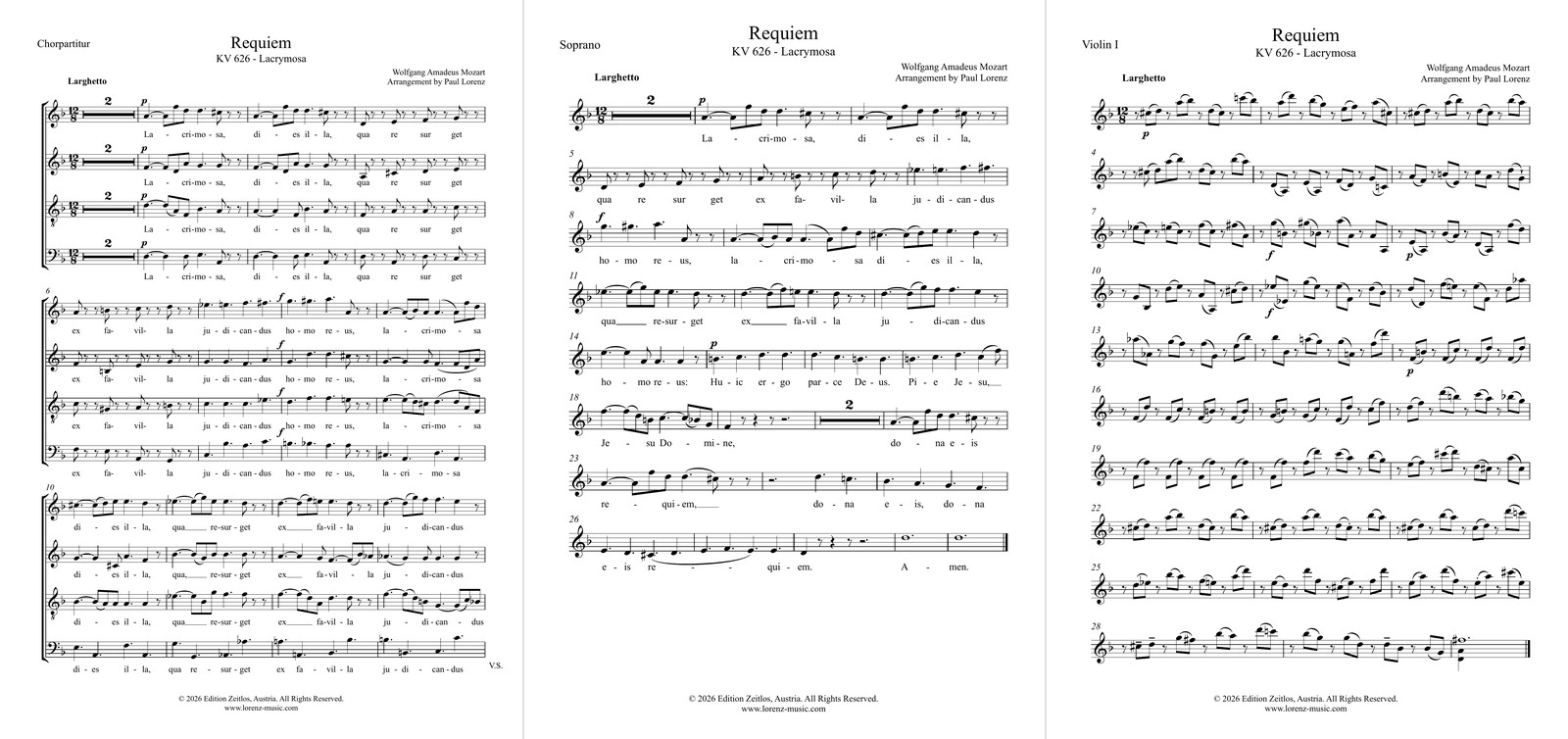
From the Complete Edition: the SATB choral score, the Soprano part and the Violin I part — opening of the Lacrimosa.
What is in the 562 pages
| Section | Pages | For whom |
|---|---|---|
| Full score | 152 | Conductor — all voices and instruments, every movement |
| Choral score (SATB) | 62 | Choir director, soloists, rehearsal |
| Basset Horn in F 1 · 2 | 19 · 20 | Woodwinds |
| Bassoon 1 · 2 | 21 each | Woodwinds |
| Trumpet in D 1 · 2 | 11 each | Brass — eleven movements |
| Trombone 1 · 2 · 3 | 13 · 13 · 12 | Brass — alto, tenor and bass trombone; the Tuba mirum solo is in Trombone 2 |
| Timpani | 10 | Ten movements |
| Soprano · Alto · Tenor · Bass | 22 · 22 · 22 · 21 | Individual voice parts, with the solo passages |
| Violin I · Violin II · Viola | 28 · 28 · 27 | Strings |
| Violoncello | 27 | The bass line for violoncello, double bass and organ (without figured bass) |
Every part contains all the movements in which it plays, in order. The bookmarks panel of any PDF reader jumps straight to, say, Trombone 2 → Tuba mirum. The parts carry their English names in the file (Basset Horn in F, Bassoon, Trumpet in D, Violin I); the choral score appears under its German name, “Chorpartitur”.
The fifteen movements
| Movement | Tempo and metre in this edition | Bars | Character |
|---|---|---|---|
| Requiem aeternam | Adagio · 4/4 | 48 | Basset horns and bassoons over pulsing strings; a soprano solo at “Te decet hymnus” |
| Kyrie | Allegro · 4/4 | 52 | Double fugue for the full choir |
| Dies irae | Allegro assai · 4/4 | 68 | The day of wrath, with trumpets and timpani |
| Tuba mirum | Andante · 2/2 | 62 | The four soloists in turn, opened by the trombone solo |
| Rex tremendae | Grave · 4/4 | 22 | Massive dotted rhythms, ending in a plea |
| Recordare | 3/4 | 130 | The longest movement — a quartet for the four soloists |
| Confutatis | Andante · 4/4 | 40 | Men’s voices against hushed women’s voices |
| Lacrimosa | Larghetto · 12/8 | 30 | Mozart’s first eight bars, completed to the closing Amen |
| Domine Jesu | Andante con moto · 4/4 | 78 | Offertory, with a solo quartet and the fugue “Quam olim Abrahae” |
| Hostias | Andante · 3/4 — Andante con moto · 4/4 | 89 | Calm in E-flat, then the fugue returns |
| Sanctus | Adagio · 4/4 — Allegro · 3/4 | 38 | Brief and festive in D major, with an Osanna fugue |
| Benedictus | Andante · 4/4 — Allegro · 3/4 | 76 | The solo quartet, then the Osanna once more |
| Agnus Dei | Larghetto · 3/4 | 51 | Forceful cries of “Agnus Dei” against quiet pleas for rest |
| Lux aeterna | Adagio · 4/4 | 30 | Returns to the music of the opening, with soprano solo |
| Cum sanctis | Allegro · 4/4 — Adagio | 52 | The Kyrie fugue on the words of the Communion |
The Requiem as it is usually performed
Every performance of the Requiem uses someone’s completion, because Mozart did not live to finish it. The completion in this edition is the one that has been sung since the first performances: its Sanctus, Benedictus and Agnus Dei belong to the Requiem as most listeners know it, and closing with Mozart’s own Kyrie fugue on the words “Cum sanctis tuis” rounds the work off. This edition gives that version complete, in the order of the liturgy, so that a choir can perform it in concert or in a Requiem Mass without rearranging anything.
If you need only the Lacrimosa — for a memorial service, a funeral or a concert programme — it is also available as a separate edition with score, choral score and all parts.
Programming the Requiem
At about fifty minutes the Requiem fills the larger part of a concert and is often paired with a short first half. Mozart’s own Ave Verum Corpus, written in the same year, and the Laudate Dominum KV 339 for soprano and choir make natural companions; for a remembrance concert, Barber’s Agnus Dei sets a very different stillness beside it. Choirs looking for Mozart in a brighter key will find it in the Coronation Mass KV 317.
More repertoire for choir and church is in the sacred choral catalogue and the choir editions. If you need clarinets instead of basset horns, a written-out organ part or a reduced orchestra for the players you have, ask before you buy — bespoke adaptation is part of what this publisher does.
Own this arrangement? Share your review →
Requiem in D minor, KV 626 sheet music — frequently asked questions
What exactly is included in the Complete Edition?
One PDF of 562 pages with all fifteen movements: the full conductor’s score (152 pages), the SATB choral score (62 pages), and individual parts for Basset Horn in F 1 (19 pages) and 2 (20), Bassoon 1 and 2 (21 each), Trumpet in D 1 and 2 (11 each), Trombone 1 and 2 (13 each) and 3 (12), Timpani (10), Soprano, Alto and Tenor (22 each), Bass (21), Violin I and Violin II (28 each), Viola (27) and Violoncello (27). PDF bookmarks take you straight to every part and movement. The file is A4, print-ready and works on a tablet.
Which version of the Requiem is this?
The completion by Franz Xaver Süßmayr, the version most choirs know. Mozart finished the Requiem aeternam and left the Kyrie, the Sequence and the Offertory as drafts — voices, bass line and the most important instrumental lines — and the first eight bars of the Lacrimosa. Süßmayr completed the orchestration, continued the Lacrimosa, composed the Sanctus with its Osanna fugue, the Benedictus and the Agnus Dei, and set the Lux aeterna and Cum sanctis to the music of Mozart’s opening and Kyrie.
What is the instrumentation?
Four soloists (soprano, alto, tenor, bass), SATB choir, 2 basset horns in F, 2 bassoons, 2 trumpets in D, 3 trombones (alto, tenor, bass), timpani, Violin I, Violin II, Viola, and one bass line for violoncello, double bass and organ. The trumpets play in eleven movements and the timpani in ten; the trombones rest in the Kyrie, the Recordare and the Sanctus, and in the Tuba mirum only the second trombone plays — its solo.
Do we need soloists?
Yes, four — soprano, alto, tenor and bass. They sing the Tuba mirum, the Recordare and the Benedictus, the quartet passage in the Domine Jesu, and the soprano has short solos in the Requiem aeternam and the Lux aeterna. Every solo passage is printed on the choir staves, marked “Solo” and “Tutti”, so soloists read from the choral score or from their voice part.
Is there a piano reduction or a separate organ part?
No. The 62-page choral score contains the four choir staves with the solo passages, without a piano reduction. The organ plays Mozart’s bass line together with violoncello and double bass; this edition prints that line as the Violoncello part, without figured bass, so the organist plays from that part or from the score. If you need a figured or written-out organ part, please ask before you buy.
Can clarinets play the basset-horn parts?
The parts are written for basset horns in F, as Mozart scored them. If your orchestra has no basset horns and you need parts for clarinets in B-flat or A, Paul Lorenz will adapt the edition on request — please get in touch before you buy.
How long does the Requiem take to perform?
About 50 to 55 minutes for all fifteen movements, depending on tempo. The edition gives tempo words but no metronome marks; the Recordare has no tempo word in the source.
How difficult is it?
The Requiem is demanding but within reach of a well-prepared amateur choir. The work in rehearsal goes into the fugues — the Kyrie, the “Quam olim Abrahae” of the Domine Jesu and the Hostias, the Osanna and the closing Cum sanctis — into the fast declamation of the Dies irae and the Confutatis, and into a wide dynamic range. The soloists need secure voices, and the second trombone plays the exposed solo of the Tuba mirum. The orchestral parts suit capable amateur and professional players.
Mozart is public domain — why buy this edition instead of a free scan?
The Requiem is public domain, and scans of old editions exist. What they do not give you is a performance library in one file: a score, a choral score, an individual part for every voice section and for every instrument — freshly engraved and matching bar for bar. The nineteenth-century complete edition, the source of this one, prints the wind instruments in pairs on one staff, the choir in soprano, alto and tenor clefs and the trombones only as a note to double the choir. The realistic alternative is not a free download; it is hire material or evenings of extracting parts before the first rehearsal.
Is the text in Latin?
Yes. The complete Latin text of the Requiem Mass is underlaid in the full score, the choral score and each of the four voice parts.
What licence do we get, and what is the refund policy?
The Requiem is in the public domain, so no royalties are due for the work itself. This edition is published by Edition Zeitlos, Austria, and your purchase licenses you to print the parts for your own ensemble and to perform the Requiem with the purchasing ensemble in concert and liturgy — you own the file, there is no rental and no return deadline. Any reporting of the public performance to a performing-rights society (GEMA/AKM/SUISA, or ASCAP/BMI/PRS elsewhere) is handled by the organiser as usual. Because the complete file is delivered immediately, downloads cannot be refunded; please study the score previews on this page, and contact us for extended sample pages before buying if you would like to see more.
How long is the launch price valid?
The Complete Edition is offered at €89.90 for its launch instead of the regular €119.00. Buy now and the file is yours at that price — including every future correction of this edition, which you can download again from your order page.
Can we buy the Lacrimosa on its own?
Yes. The Lacrimosa is also available as a separate edition — full score, choral score and all eighteen parts in one PDF of 28 pages, the same engraving as in this Complete Edition — for concerts, memorial services and funerals where only this movement is sung.
What is the Paul Lorenz Masterclass?
A rehearsal app in the browser for phone, tablet and computer – nothing to install. You practise your part to the orchestral playback of the Requiem and add every choir part on its own: sung, on the piano or not at all. The score follows the music with your part highlighted; tempo 50–100 % without changing pitch, loops for tricky bars and the starting note at a tap. All fifteen movements are included, and the solos sit in the part they belong to. Try it free: Requiem aeternam, bars 7–14 with the choir’s entry, right on this page.
How does our choir get access to the Masterclass?
The Complete Edition includes one personal access for you. For your choir there are packs of 10, 25 or 50 access codes – from €3.50 per singer, right here even without the sheet music, or on your download page. You hand the codes out to your singers. Each code is for one person on up to three of their own devices. Individual singers – including choirs that use a different edition of the Requiem – buy their own access here for €9.90.
Is the Masterclass a subscription?
No. You pay once per work; the access code arrives by e-mail instantly, with a PDF invoice.
Can the edition be adapted?
Yes — bespoke adaptation is a core service of Paul Lorenz. Clarinet parts instead of basset horns, a separate double-bass part, an organ part, transpositions or a reduced orchestra for the forces you actually have are available on request. Please get in touch before you buy.
Can I play the Basset horn in F I part on Clarinet in B♭?
Yes. The Part Configurator is included in the price: the Basset horn in F I part is also available for Flute, Oboe, Clarinet in B♭ and Soprano saxophone in B♭ and 4 more instruments – transposed, in the right clef, checked for range and breathing. You receive the link by e-mail after your purchase.
Which parts are available for other instruments?
12 instrumental parts for 15 instruments in all. The overview “Parts for your instrumentation” on this page lists every original part with its instruments. For a different instrumentation you can send Paul Lorenz a request after your purchase.
Am I allowed to use the re-scored parts?
Yes. Parts from the Part Configurator belong to the edition you bought and are covered by the same license – for your ensemble, with the same rights of use. Every part carries the notice “Licensed to …” in its footer. For public performances the organiser registers the performance with the collecting society as usual (e.g. PRS, ASCAP/BMI, GEMA).