Haydn Little Organ Mass Sheet Music — Missa brevis in B-flat, Hob. XXII:7
The complete performance edition of Haydn’s “Kleine Orgelsolomesse” — full score, choral score and all eight individual parts for SATB choir, soprano solo, two violins, violoncello and organ in one PDF. Edited by Paul Lorenz.
Regular price €119.00
Now
€89.90
Instant PDF download
See the score & buy
Edition facts
Little Organ Mass (Missa brevis Sancti Joannis de Deo) by Joseph Haydn, arranged by Paul Lorenz (Complete Edition — Full Score, Choral Score & All Parts edition): full score (31 pages) and separate parts (86 pages), delivered as a PDF (A4) for instant download, €89.90.
- Instrumentation
- Organ · Violin I, Violin II, Cello
- Choir
- SATB
- Soloists
- Soprano soloist
- Pages
- 117 pages — full score (31) + separate parts (86)
- Key
- B♭ major
- Duration
- approx. 15 min
- Difficulty
- Intermediate (3/5)
- Tempo
- Adagio – Allegro molto
- Edition
- 2026
- Format
- PDF, A4, instant download
Read from the PDF you download.
Joseph Haydn’s Missa brevis Sancti Joannis de Deo in B-flat major, Hob. XXII:7 — the “Little Organ Mass”, in German the “Kleine Orgelsolomesse” — is about fifteen minutes of music for the forces almost every parish can muster: SATB choir, one solo soprano, two violins, a bass line and organ. This is the complete performance edition by Paul Lorenz: conductor’s score, choral score and every individual part, delivered as one instant PDF download you own outright. Launch price €89.90 (regular price €119.00).
The edition is laid out for rehearsal and service. Every singer gets an individual part as well as the choral score, the organ part is written out on two staves including the solo of the Benedictus, and the two violins and the violoncello each have their own part — 117 pages in one file, bookmarked by part and movement. All six movements are included, with the complete Latin text underlaid in the score, the choral score and every voice part.
Hear the arrangement
A one-minute excerpt from the Benedictus — the soprano solo with obbligato organ — from Paul Lorenz’s recording. The edition you download is the full score, choral score and all parts shown in the preview.
Choose your “Little Organ Mass (Missa brevis Sancti Joannis de Deo)” edition
Complete Edition — Full Score, Choral Score & All Parts
117 pages: score + parts · PDF (A4)
Every part also for other instruments – included ↓
One PDF, 117 pages: conductor’s score, SATB choral score and eight individual parts — Soprano, Alto, Tenor, Bass, Violin I, Violin II, Violoncello and an organ part on two staves.
- Instant PDF download
- Secure checkout
- Licensed edition
Parts for your instrumentation
Every instrumental part of this edition is also available for other instruments – included in the price. Transposed, in the right clef, checked for range and breathing.
| Original part | Also available for |
|---|---|
| Soprano | Oboe, Clarinet in B♭, Soprano saxophone in B♭, Violin, English horn in F, Viola |
| Alto | Flute, Oboe, Clarinet in B♭, Soprano saxophone in B♭, Violin, Alto saxophone in E♭, English horn in F, Flugelhorn in B♭, Viola, Tenor saxophone in B♭, Bassoon, Bass clarinet in B♭, Cello |
| Tenor | Flute, Oboe, Clarinet in B♭, Soprano saxophone in B♭, Violin, Alto saxophone in E♭, Horn in F, English horn in F, Viola, Tenor saxophone in B♭, Bassoon, Bass clarinet in B♭, Cello |
| Bass | Alto saxophone in E♭, Viola, Tenor saxophone in B♭, Bassoon, Bass clarinet in B♭, Cello, Double bass |
| Violin I | Clarinet 1+2 in B♭, Viola |
| Violin II | Clarinet 1+2 in B♭, Viola |
| Cello | Viola, Bassoon, Bass clarinet in B♭, Double bass |
“1+2”: a part divided for two players. Where the original part has double stops or chords, two wind players share the notes – marked “div.” and “a 2”.
In your key. The whole edition is also available in B major or C major (original: B♭ major) – score and all parts in the new key, as one PDF, included in the price. We only offer keys in which every part stays within its instrument’s range; where a single instrumental phrase would otherwise fall outside it, it is set an octave higher or lower.
Buy. After your purchase you receive your personal link to the Part Configurator by e-mail.
Choose part and instrument. For example the Soprano part as Clarinet in B♭.
Download the PDF. The first time a part is requested it takes about a minute to set; after that it is ready at once – with your name as the license notice.
How the Part Configurator works → Need a different instrumentation? After your purchase you can send Paul Lorenz a request.
New
Paul Lorenz Masterclass
Practise your part – in the browser on phone, tablet or computer, nothing to install.
- The accompaniment of the work plus every choir part on its own: sung, on the piano or off
- The score follows the music, with your part highlighted
- Tempo 50–100 % without changing pitch, loops for tricky bars, starting note
- Presets: Learn, In the choir, I sing it myself, Full choir
The opening of the piece, every feature, no sign-up
Your own access for your part – no sheet music purchase needed, even if your choir sings from a different edition.
Buy access – €9.90One-off, no subscription · code by e-mail instantly · Buying the sheet music includes one personal access.
For your whole choir
Packs of 10, 25 or 50 access codes – from €3.50 per singer. You receive the codes at once and hand them to your singers.
Quality in detail
- Everything in One PDF: Full score, SATB choral score and eight individual parts for all six movements — 117 pages in a single download, with PDF bookmarks for every part and every movement. Print the pages you need, nothing to order separately, yours to keep and reprint every season.
- Organ Part on Two Staves: The organ part is written out for both hands — the accompaniment of the choral movements and the obbligato solo of the Benedictus that gives the mass its name. Thirteen pages, all six movements.
- A Part for Every Singer: Besides the 17-page choral score, sopranos, altos, tenors and basses each get their own part with only their line and text. The soprano part carries the Benedictus solo, marked “Solo” where it begins and “Tutti” where the choir returns for the Osanna.
- Small Forces, Full Mass: Two violins, violoncello and organ — the classical Viennese church trio. No violas, no winds, no timpani to hire. The violoncello part carries the bass line throughout.
- The Complete Ordinary in a Quarter of an Hour: Kyrie, Gloria, Credo, Sanctus, Benedictus and Agnus Dei. In the Gloria and the Credo Haydn lets the four voices sing different lines of the text at the same time — the Gloria is over after 31 bars — so the mass fits an ordinary Sunday liturgy without cuts.
- Freshly Engraved: New engraving in A4 with consistent layout, movement titles, tempo marks and bar numbers at the start of every system in score and parts — print-ready and comfortable on a tablet.
Haydn’s Little Organ Mass sheet music at a glance
| Work | Missa brevis Sancti Joannis de Deo in B-flat major, Hob. XXII:7, “Kleine Orgelsolomesse” / “Little Organ Mass” — Joseph Haydn, 1770s, for the Brothers Hospitallers in Eisenstadt; public domain |
| Movements | Kyrie · Gloria · Credo · Sanctus · Benedictus · Agnus Dei |
| Duration | approx. 15 minutes |
| Voicing | SATB choir with soprano solo in the Benedictus (marked Solo / Tutti in the soprano staff) |
| Instrumentation | Violin I, Violin II, Violoncello, Organ |
| What you receive | One PDF, 117 pages: full score (31 pages), choral score (17 pages), eight individual parts — bookmarks for every part and movement |
| Text | Latin (complete Ordinary) |
| Edition | Paul Lorenz — arrangements recorded with the London Symphony Orchestra at Abbey Road Studios |
| Format | High-resolution PDF, A4 — instant download, print-ready and tablet-friendly |
| Licence | Public-domain work; edition © 2026 Edition Zeitlos, Austria. Print for your ensemble, perform in concert and liturgy — no rental, no return deadline |
| Price | €89.90 launch price (regular €119.00) |
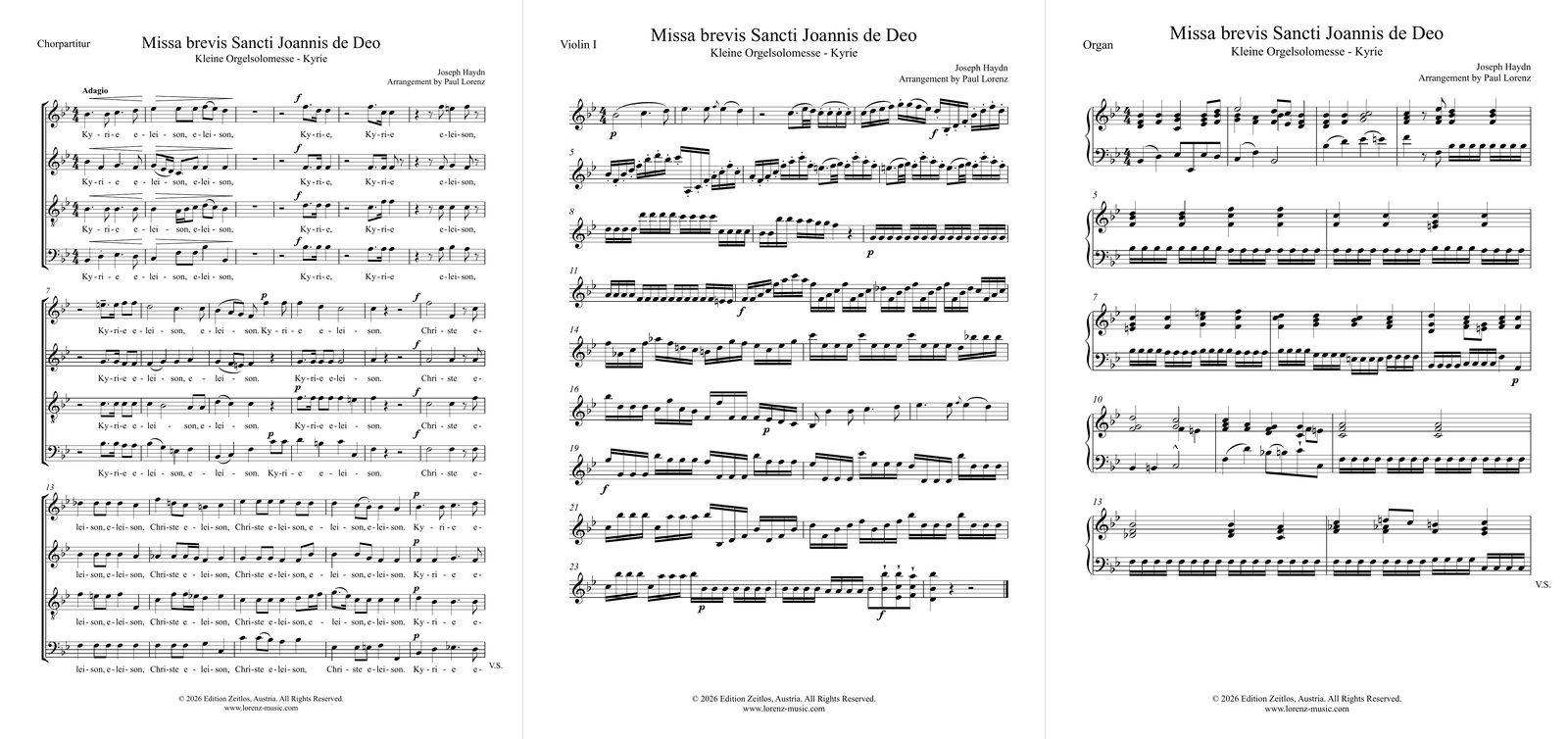
From the Complete Edition: the SATB choral score, the Violin I part and the organ part — opening of the Kyrie.
What is in the 117 pages
| Section | Pages | For whom |
|---|---|---|
| Full score | 31 | Conductor — all voices and instruments, every movement |
| Choral score (SATB) | 17 | Choir director, rehearsal pianist, soloist |
| Soprano | 8 | Individual voice part, including the Benedictus solo |
| Alto · Tenor · Bass | 7 each | Individual voice parts for the choir sections |
| Violin I · Violin II | 9 each | Strings |
| Violoncello | 9 | Strings — the bass line of the mass |
| Organ | 13 | Organist — two staves, including the solo of the Benedictus |
Every section contains all six movements in order. The bookmarks panel of any PDF reader jumps straight to, say, Organ → Benedictus. The choral score appears there under its German name, “Chorpartitur”.
The six movements
| Movement | Tempo and metre in this edition | Bars | Character |
|---|---|---|---|
| Kyrie | Adagio · 4/4 | 25 | A calm, songful opening over moving strings |
| Gloria | Allegro molto · 3/4 | 31 | The whole text in under a minute — each voice sings a different line at the same time |
| Credo | Allegro · 4/4 — Adagio · 3/4 (Et incarnatus est) — Allegro | 82 | Brisk outer sections around a hushed, slow centre |
| Sanctus | Allegro · 6/8 | 30 | Short and bright, with a swinging Osanna |
| Benedictus | Moderato · 4/4 — Allegro · 6/8 (Osanna) | 71 | The heart of the mass: soprano solo with obbligato organ, then the choir’s Osanna |
| Agnus Dei | Adagio · 3/4 | 73 | Quiet and sustained, closing with the Dona nobis pacem |
Why the “Little Organ Mass” is sung so often
Haydn wrote this mass for a small chapel and modest forces, and that is exactly why it has never left the repertoire. A choir can learn it in a few rehearsals; two violins, a bass instrument and the organ are enough to accompany it; and in a quarter of an hour the whole Ordinary has been sung. The telescoped Gloria and Credo — several lines of the text at once — were a practical answer to a short liturgy, and they still are. Against that brevity stands the Benedictus, where Haydn takes his time: a soprano solo and an organ part that answer each other like two singers.
Programming the Little Organ Mass
At about fifteen minutes the mass fits a Sunday service as easily as a feast day, and it is a natural choice wherever a small ensemble accompanies the choir. In concert it pairs well with Mozart’s Ave Verum Corpus or stands beside a second short mass. Choirs that enjoy it will find the same Classical idiom on a larger scale in Mozart’s Sparrow Mass KV 220 and Coronation Mass KV 317.
More repertoire for choir and church is in the sacred choral catalogue and the choir editions. If you need a transposition, an added instrument or a voicing adapted to the singers you actually have this season, ask before you buy — bespoke adaptation is part of what this publisher does.
Own this arrangement? Share your review →
Little Organ Mass (Missa brevis Sancti Joannis de Deo) sheet music — frequently asked questions
What exactly is included in the Complete Edition?
One PDF of 117 pages with all six movements (Kyrie, Gloria, Credo, Sanctus, Benedictus, Agnus Dei): the full conductor’s score (31 pages), the SATB choral score (17 pages), and individual parts for Soprano (8 pages), Alto, Tenor and Bass (7 pages each), Violin I, Violin II and Violoncello (9 pages each) and Organ (13 pages). PDF bookmarks take you straight to every part and movement. The file is A4, print-ready and works on a tablet.
What is the instrumentation of Haydn’s Little Organ Mass?
SATB choir with a soprano solo in the Benedictus, Violin I, Violin II, a bass line and organ — the scoring known as the Viennese church trio. There is no viola part. In this edition the bass line is the violoncello part; a double bass can read from the same part. The organ plays in every movement and has the solo in the Benedictus.
Why is it called the “Little Organ Mass”?
Because of the Benedictus: a long soprano solo accompanied by an obbligato organ part that sings and ornaments like a second soloist. “Little” distinguishes it from Haydn’s earlier and larger “Great Organ Mass” in E-flat. The Latin title, Missa brevis Sancti Joannis de Deo, names Saint John of God, the patron of the Brothers Hospitallers; Haydn wrote the mass in the 1770s for their chapel in Eisenstadt.
How long does the mass take to perform?
About fifteen minutes for all six movements. The Gloria takes less than a minute, because the four voices sing different lines of the text simultaneously; the Benedictus with its soprano and organ solo is the longest movement.
Do we need a soloist?
One soprano, for the Benedictus. The solo is printed in the soprano part and in the soprano staff of the scores, marked “Solo” and “Tutti”, so it can be taken by a guest soloist or by a secure soprano from the choir. The other movements are for choir throughout.
Can we perform it with choir and organ alone?
The organ part contains the harmony of every movement, so choir and organ can rehearse the whole mass from this material and sing it in a service when no strings are available. The two violins carry much of the figuration, though — the mass sounds as Haydn wrote it only with them. If you need a different scoring, Paul Lorenz adapts the edition on request; please ask before you buy.
How difficult is it?
The choral writing is short, mostly homophonic and learns quickly; the work in rehearsal goes into clear diction where the voices sing different texts at once, and into a quiet, sustained Agnus Dei. The Benedictus needs a soprano with an easy top and an organist who enjoys a solo. The violin parts lie comfortably for good amateur players.
Haydn is public domain — why buy this edition instead of a free scan?
Haydn’s music is public domain, and scans of old editions exist. What they do not give you is a performance library in one file: a full score, a choral score, an individual part for every voice section, two violin parts, a violoncello part and an organ part written out on two staves — freshly engraved and matching bar for bar. The realistic alternative is not a free download; it is evenings of copying and extracting parts before the first rehearsal.
Is the text in Latin?
Yes. The complete Latin Ordinary is underlaid in the full score, the choral score and each of the four voice parts.
What licence do we get, and what is the refund policy?
Haydn’s composition is in the public domain, so no royalties are due for the work itself. This edition is published by Edition Zeitlos, Austria, and your purchase licenses you to print the parts for your own ensemble and to perform the mass with the purchasing ensemble in concert and liturgy — you own the file, there is no rental and no return deadline. Any reporting of the public performance to a performing-rights society (GEMA/AKM/SUISA, or ASCAP/BMI/PRS elsewhere) is handled by the organiser as usual. Because the complete file is delivered immediately, downloads cannot be refunded; please study the score previews on this page, and contact us for extended sample pages before buying if you would like to see more.
How long is the launch price valid?
The Complete Edition is offered at €89.90 for its launch instead of the regular €119.00. Buy now and the file is yours at that price — including every future correction of this edition, which you can download again from your order page.
Can the edition be adapted?
Yes — bespoke adaptation is a core service of Paul Lorenz. Transpositions, added or alternative instruments, a separate double-bass part or a voicing that fits the singers you have this season are available on request. Please get in touch before you buy.
What is the Paul Lorenz Masterclass?
A rehearsal app in the browser for phone, tablet and computer – nothing to install. You practise your part to the playback of the mass with strings and organ and add every choir part on its own: sung, on the piano or not at all. The score follows the music with your part highlighted; tempo 50–100 % without changing pitch, loops for tricky bars and the starting note at a tap. All six movements are included, and the soprano solo of the Benedictus sits in the soprano part. Try it free: Kyrie, bars 1–9, right on this page.
How does our choir get access to the Masterclass?
The Complete Edition includes one personal access for you. For your choir there are packs of 10, 25 or 50 access codes – from €3.50 per singer, right here even without the sheet music, or on your download page. You hand the codes out to your singers. Each code is for one person on up to three of their own devices. Individual singers – including choirs that use a different edition of the mass – buy their own access here for €9.90.
Is the Masterclass a subscription?
No. You pay once per work; the access code arrives by e-mail instantly, with a PDF invoice.
Can I play the Soprano part on Clarinet in B♭?
Yes. The Part Configurator is included in the price: the Soprano part is also available for Oboe, Clarinet in B♭, Soprano saxophone in B♭ and Violin and 2 more instruments – transposed, in the right clef, checked for range and breathing. You receive the link by e-mail after your purchase.
Which parts are available for other instruments?
3 instrumental parts and 4 choir voices for 15 instruments in all. The overview “Parts for your instrumentation” on this page lists every original part with its instruments. For a different instrumentation you can send Paul Lorenz a request after your purchase.
Can an instrument play one of the choir voices?
Yes. The choir voices are available as instrumental parts too – Alto for Cello, for example: transposed, in the right clef, without the lyrics, checked for range and breathing.
Is this edition available in another key?
Yes. The whole edition is also available in B major or C major (original: B♭ major) – score and all parts in the new key, as one PDF, included in the price. We only offer keys in which every part stays within its instrument’s range; where a single instrumental phrase would otherwise fall outside it, it is set an octave higher or lower. You choose the key in the Part Configurator after your purchase.
Am I allowed to use the re-scored parts?
Yes. Parts from the Part Configurator belong to the edition you bought and are covered by the same license – for your ensemble, with the same rights of use. Every part carries the notice “Licensed to …” in its footer. For public performances the organiser registers the performance with the collecting society as usual (e.g. PRS, ASCAP/BMI, GEMA).