Sheet Music Guide • Orchestral & Choral Repertoire
This Is Me (The Greatest Showman): The Complete Guide to Orchestra and Choir Sheet Music
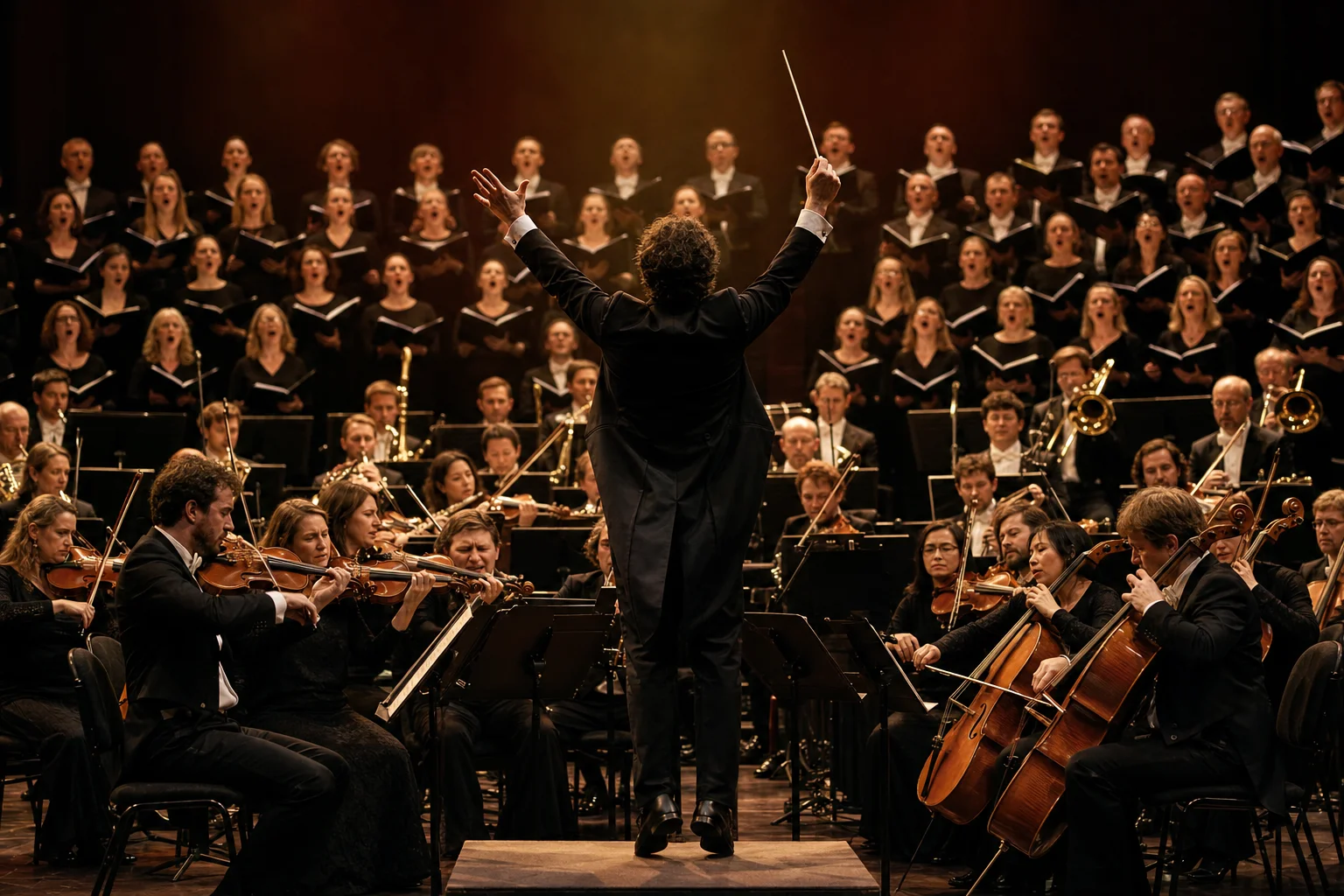
“This Is Me” by Pasek & Paul is available as two professional arrangements: a full orchestra and SATB choir score (€69.90) and a piano & SATB choir reduction (€39.90). Both editions deliver instant PDF download with conductor score and individual parts. The full orchestra edition suits symphony concerts and large venues; the piano version is ideal for school concerts, church events, and smaller halls.
At a Glance
- Two editions available: full orchestra & choir (€69.90) and piano & choir (€39.90) — both as instant PDF download
- The Greatest Showman soundtrack reached No. 1 in 48 countries (Billboard, 2018) — audience recognition is virtually guaranteed
- Written in B-flat major with a climactic soprano high B-flat — suited to advanced amateur and professional ensembles
- Three-rehearsal programme recommended: sectional work, balance rehearsal, and full run with orchestra
- A bespoke transposition to A-flat major is available on request for lighter soprano sections
- Vienna State Opera
- Abbey Road Studios
- London Symphony Orchestra
- 30 Years of Professional Orchestration
Why “This Is Me” Works Brilliantly with Full Orchestra and Choir
The Greatest Showman soundtrack reached No. 1 in 48 countries and spent more than two years on the Billboard 200 chart (Billboard, 2018). That level of cultural saturation means concert audiences do not merely recognise “This Is Me” — they arrive already emotionally invested in it. Few contemporary songs offer a conductor that gift.
The reason the song translates so naturally to the concert stage is structural. Pasek & Paul wrote “This Is Me” in B-flat major — a key that sits comfortably in the SATB concert range and carries a characteristic warmth in the brass choir. Standard choral pedagogy identifies B-flat major as one of the most acoustically advantageous keys for SATB writing precisely because it keeps all four voices in their most resonant registers for the majority of the phrase.
The Architectural Arc: From Intimate Verse to Anthemic Chorus
The song’s formal architecture does something rare in contemporary songwriting: it begins at near-solo dynamic and builds to a full choir climax that is entirely organic, not imposed. The verse sits in the mid-range for all voices, allowing a choir to sing with minimal vibrato and maximum text clarity. As the pre-chorus accumulates harmonic tension, each section can begin to open its tone. By the time the chorus arrives, the choir has earned the full sound — and the audience feels it.
The harmonic language is rooted in the gospel tradition. The IV–I resolution that anchors the chorus phrase (“I am brave, I am bruised”) carries the same emotional weight as the same progression in Thomas Dorsey’s “Precious Lord.” That ancestry is not accidental; Pasek & Paul have spoken publicly about writing toward emotional catharsis rather than pop-radio formula. The result is a song that responds to serious orchestral treatment in a way that most contemporary hits do not.
“This Is Me” won the Golden Globe for Best Original Song in 2018 and was performed at the Academy Awards by Keala Settle, whose original Broadway casting embodied the song’s theatrical weight. That theatrical lineage — anthem of a circus of outcasts — gives conductors a narrative to communicate to their ensembles during rehearsal. Choirs perform this song better when they understand what it is about.
Choosing the Right Edition: Full Orchestra vs. Piano & Choir
The single most common question I receive from conductors about this arrangement is: which edition is appropriate for my ensemble? The answer depends on three practical factors — venue size, ensemble resources, and the concert’s programming context — not on artistic ambition.
Full Orchestra & SATB Choir — €69.90
The full orchestra edition contains a complete conductor score and individual parts for all sections: strings (Violin I, Violin II, Viola, Cello, Double Bass), brass (Horn in F × 4, Trumpet in B-flat × 2, Trombone × 2, Bass Trombone, Tuba), woodwind (Flute, Oboe, Clarinet in B-flat × 2, Bassoon), and percussion (Timpani, Snare, Bass Drum, Crash Cymbals, suspended Cymbal). The SATB choir parts are included as separate PDF files formatted for individual singer use.
This edition is the right choice when the venue has a minimum capacity of around 400 seats and the acoustic matches orchestral projection. Outdoor concerts, stadium events, and symphony hall programmes all benefit from the full orchestration. The brass writing on the final chorus creates a physical presence — the kind that audiences remember long after the evening is over.
Piano & SATB Choir — €39.90
The piano and choir edition uses a full piano reduction that preserves every harmonic colour of the orchestral score. It is not a simplification; the piano part is technically demanding and requires a confident accompanist. This edition is the appropriate choice for school concerts, church venues, community choir performances, and any situation where assembling an orchestra is logistically prohibitive.
Many conductors programme both editions across a single season — the choir edition for autumn concerts, the orchestra edition for the spring gala. Purchasing both is cost-effective given the ensemble’s rehearsal investment: once a choir has learned the SATB parts from the piano edition, transitioning to the orchestral version requires only the balance adjustment work described in the rehearsal section below.
Full Orchestra & SATB Choir
Full Production- Complete conductor score
- 30+ individual orchestral parts
- SATB choir parts included
- Instant PDF download
- A4 & US Letter formats
Piano & SATB Choir
Flexible Format- Full piano reduction score
- SATB choir parts included
- Suitable for all venue sizes
- Instant PDF download
- A4 & US Letter formats
If your concert includes other pieces by Pasek & Paul, the companion arrangement of “A Million Dreams” for full orchestra (€59.90) creates a natural two-song Greatest Showman sequence that programmes effectively as an Act I closing pair.
Rehearsal Strategy for “This Is Me”
A song of this profile — well-known to every singer in the choir, emotionally charged, with a technically demanding climax — benefits from a specific rehearsal sequence. The risk with beloved repertoire is that familiarity breeds imprecision: singers rely on their memory of the recording rather than the score in front of them. Three disciplined rehearsals are sufficient to produce a concert-ready performance.
Rehearsal One: Sectional Work and Note-Learning
The first rehearsal should address all four voices in isolation before any tutti singing. The soprano and alto parts share most of their phrase boundaries, which means any rhythmic drift between the two upper voices compounds quickly into pitch uncertainty. A ten-minute soprano-alone session on the verse followed by a combined SA run is more efficient than starting the full choir from bar one.
The tenor and bass parts carry the harmonic foundation on the chorus but spend much of the verse in relatively static supporting lines. Use the first twenty minutes of the TB rehearsal to establish the dynamic ceiling in the verse — many tenors will push too hard too early when they recognise the song, and retraining that instinct in session one is easier than correcting it in the dress run.
Rehearsal Two: The Balance Rehearsal (Sitzprobe Equivalent)
The central technical challenge in “This Is Me” is the soprano high B-flat 5 at the climax of the final chorus. This pitch sits at the upper limit of comfortable mezzo-soprano range and requires genuine soprano weight to project above a full orchestra. Do not accommodate a weak soprano section by reducing the orchestral dynamic: instead, dedicate fifteen minutes of rehearsal two to the soprano section singing the climax phrase with piano accompaniment at full concert volume, working on breath support and resonance placement before reintroducing the full texture.
Balancing choir against brass in a full orchestral context always requires more time than conductors expect. The problem is not volume — it is spectral competition. Trombones and choir tenors occupy almost identical frequency ranges. A useful solution is to ask the tenors to shift their vowel slightly forward on the “ah” of “afraid” in bar 72, which opens the mouth position and lifts their energy slightly above the trombone band. This is a subtlety, but it produces an audible result in the hall.
For detailed guidance on structuring a combined ensemble event, see our complete article on programming a choir and orchestra concert, which covers ensemble sizing ratios, stage layout, and the sitzprobe scheduling sequence in full.
Rehearsal Three: Full Dress Run
By the third rehearsal, all technical problems should be resolved. This session exists for two purposes: building ensemble confidence and refining the dynamic shape of the full piece from pianissimo verse through to fortissimo finale. Run the piece complete without stopping at least twice. Spot-fix only the two or three moments that genuinely require it. Singers and orchestra players perform better in concert when they have experienced the piece as an unbroken arc in rehearsal.
Frequently Asked Questions
What is included in the Full Orchestra edition of This Is Me?
The Full Orchestra edition includes a complete conductor score and individual parts for all orchestral sections: strings, brass (horn, trumpet, trombone, tuba), woodwind (flute, oboe, clarinet, bassoon), and percussion. The SATB choir parts are included as separate PDF files formatted for individual singer use. All files are delivered as an instant PDF download in both A4 and US Letter formats. No additional purchase is required — all parts are included in a single download.
What difficulty level is the This Is Me choir arrangement?
The arrangement is written for advanced amateur to professional choral ensembles, broadly equivalent to Grade 6–8 difficulty. The soprano part requires a sustained high B-flat 5 on the climax phrase, which demands secure upper register technique. All other voice parts remain within comfortable SATB concert ranges throughout. Most competent choirs will master the arrangement within three to four focused rehearsals. A transposition to A-flat major is available for ensembles with lighter soprano sections — contact Paul Lorenz Music before purchasing.
Do I need a performance licence to perform This Is Me in concert?
Yes. “This Is Me” is a contemporary copyright work and requires a public performance licence for any concert use. In the United States, licences are issued by ASCAP, BMI, or SESAC. In the United Kingdom by PRS for Music. In Germany and Austria by GEMA. Most established concert venues hold blanket performance licences that cover standard popular repertoire — confirm the coverage with your venue administrator before programming the piece. The sheet music licence covers reproduction for rehearsal use only and does not include public performance rights.
Can the This Is Me arrangement be transposed to a different key?
Yes. Paul Lorenz Music offers bespoke transposition for all arrangements. The standard edition is written in B-flat major, which suits most professional and advanced amateur soprano sections. Conductors working with lighter sopranos sometimes request a transposition to A-flat major, which lowers the climax pitch by a whole tone. Contact Paul Lorenz Music with your specification before purchasing and a transposed version can be prepared. Customisation is available for professional, educational, and non-profit ensembles.